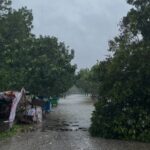
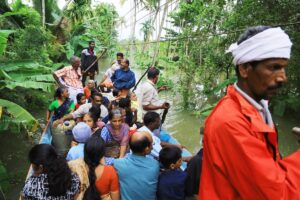
In 2018, during the Kerala floods, we left our home at night. The roads were submerged and the water rising to our necks. It was around 9:30 pm. We didn’t carry what we needed, but what panic allowed us to. At that age, I did not yet have the language to call it displacement or disaster. I only knew the fear of moving through water that erased roads, boundaries, and certainty. We all held hands together. When we reached the camp it was like a second life but it is not the one we built. It took a while to recover. Cleaning the silt, buying new things, missing things, a kurta you liked the most, the photo album, your certificates and documents and certainly the brothers and sisters you lost. Everybody still talks about each and every second of that night.
In the years since, conversations in our locality have rarely centered on those of us who evacuated and came back. We were lucky, our houses stood. They centered around the families who lost entire homes, livelihoods, and kin, to the ones for whom the flood did not end when the water receded. Even in memory, attention moves toward the worst-affected, as if acknowledging that proximity to disaster exists on a spectrum, not as a single experience.
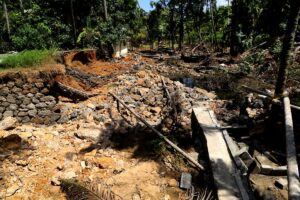
This understanding sharpened when years later, in an August talking about disasters at the college hostel. I had a conversation with a young woman named Swetha from Wayanad district of Kerala who worked in the aftermath of the Mundakkai landslide. She spoke quietly about her task, cleaning what was brought in from the mud. Often, it was not a body, It was parts, hands, legs, torsos, indistinguishable, earth-covered, demanding care even in death. There was no drama in her telling, only exhaustion. I asked her ‘what do you do when the monsoon starts?’
There was a calm on her face “We are ready for what comes. What else can we do? We’ll try to get out and have a new life but there is a chance that we could lose it all. We just accept that.” The intimacy of labor and strength it demanded, the kind that disaster reports never record, is with me forever.
What stayed with me from those nights is not just water, it was a sense of what survival meant. Even after the danger passed, loss was still there, in the compromised and in broken routines. Here I learned that disasters are not singular events, they are prolonged experiences that will stay in the homes, bodies and memories. And these experiences are not isolated or exceptional. This story is not mine only.In recent years these scenes are repeating across India from northeast to western ghats, from himalayas to western plains.
According to the Indian Meteorological Department in 2024, floods and heavy rains caused 1287 deaths in 2024. The scale of impact is even more staggering when disasters are measured in lives disrupted than lives lost. During the 2018 Kerala floods over 400 people lost their lives, yet over 5.4 million people’s lives were impacted, a number comparable to the entire population of Singapore.
Floods today are no longer isolated “natural” events; they intersect with unplanned urbanization, fragile rural infrastructure, and altered river systems, making disasters increasingly predictable in occurrence but deeply unpredictable in impact. What remains uncertain is not whether floods will happen, but who will be affected, how severely, and for how long. Despite this, relief responses often priorities immediate survival like food packets, temporary shelters, and medical aid, while neglecting the longer arc of recovery.
Most aid interventions remain supply-driven rather than need-driven. Communities are treated as passive recipients of assistance rather than as knowledge-holders with contextual expertise about their land, livelihoods, seasons, and risks. Relief is frequently measured in terms of speed, scale, and visibility, but rarely through dignity, relevance, or sustainability.
This approach also flattens the differences. It assumes that all affected populations need the same solutions, ignoring livelihood loss, psychosocial trauma, erosion of social roles, and long-term resilience. During the 2018 Kerala floods fishermen of Kollam district of Kerala came together with their boats and saved thousands of people who were stranded on the terraces. This shows the use of local knowledge in times of distress.
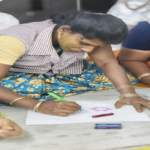
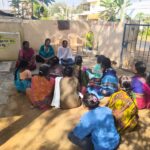
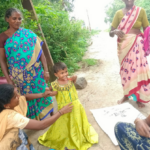
Goonj works through ‘Rahat’ initiative by listening before intervention and initiating community-led recovery. It is not top-down relief, it uses local labor, skills, and priorities, breaking rural–urban hierarchies through exchange. The Goonj way is changing the narrative of disaster relief. Goonj’s work suggests that flood response need not begin with distribution, but with dialogue and that recovery is as much about restoring dignity as it is about rebuilding infrastructure. Our job is to take all this into account rather than making a one size fits all approach to disaster.
THE GOONJ WAY
Goonj has devised a way to respond to climate emergencies, the SARRD meaning societal Alliance for Resilience and Response to disasters. It is focused on resource mobilization, urban civic participation, local partnerships, involvement of local communities and consistent learning. This is a community centered approach which is built on inclusivity, equity, sustainability, long term resilience and multi stakeholder engagement. Here solutions are co-created.
This is not an alternative to the state, but a necessary complement, one that centers people rather than protocols.As floods become a recurring feature of our climate reality, the question is no longer whether we can respond faster, but whether we can respond better, with humility, dignity, and trust in the people who live with water long after the headlines fade. Listening may not stop floods, but it can prevent disasters from becoming permanent vulnerability.
By Varsha Valsan
Goonj Setu Fellow, 2025-2026