Deep Listening as Development Practice: What Goonj Hears Beyond the Indexes
Development today speaks the language of numbers. Life expectancy, years of schooling, income levels, multidimensional deprivations, gender gaps…these indicators help us compare, prioritize, and allocate. They are powerful, necessary tools. Yet, they share a common limitation: they describe outcomes without listening to conditions. They measure what is, but rarely attend to how it is lived.
This is where the practice of deep listening becomes crucial as a development ethic. Organizations like Goonj demonstrate that before development can intervene meaningfully, it must listen first slowly, contextually, and without presuming to know.
What We Usually Call “Listening” in Development
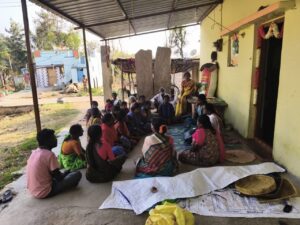
In development work, listening is often procedural in process. Surveys are conducted, needs assessments are filled, consultations are held. Communities speak, data is collected, and priorities are tabulated. This form of listening is efficient, but it is also extractive. It listens for answers rather than for understanding. It reduces complex lives into tick boxes, thresholds, and categories.
Deep listening, by contrast, is not interested in immediate clarity. It does not rush to solutions. It stays with ambiguity. It allows people to articulate needs in their own language, shaped by their own histories and social realities. Goonj’s work is rooted in this kind of listening, rooted in attention rather than assumption.
Goonj: Beginning with Attention, Not Indicators
Goonj does not start with a predefined problem statement. It starts with conversations. Whether it is about clothing, sanitation, menstrual health, or rural infrastructure, the organization listens to how communities themselves understand dignity, work, and value. Its well-known Cloth for Work initiative is not a charity model responding to “lack of income,” but a dialogue that recognizes labor, contribution, and self-respect. This approach quietly challenges the logic of many development indices.
Human Development Index (HDI): Measuring Outcomes, Missing Agency
The Human Development Index focuses on health, education, and income, critical components of human well-being. However, HDI treats development as an improvement in outcomes rather than a restoration of agency. Two communities with identical HDI scores may experience development very differently depending on how decisions are made, whose voices are heard, and how dignity is negotiated.
Goonj’s listening-led interventions foreground agency. By allowing communities to define priorities, be it a broken road, lack of menstrual cloth, or unsafe water access, it shifts development from delivery to participation. Deep listening reveals that development is not only about living longer or earning more, but about being recognized as capable contributors to one’s own improvement.
Multidimensional Poverty Index (MPI): Dimensions Without Meaning
The Multidimensional Poverty Index marks an important shift by recognizing that poverty is not merely about income. It looks at health, education, and living standards together. Yet, even MPI struggles to capture the meaning of deprivation. It can tell us that a household lacks sanitation, but not how shame, safety, or social exclusion are woven into that lack.
For example menstrual cloth is not merely a health input; it is tied to mobility, attendance, silence, and stigma. These are dimensions that rarely appear in indices but surface immediately when people are listened to without judgment or haste.Where MPI disaggregates poverty into components, deep listening reintegrates them into lived experience.
Gender Inequality Index (GII): When Inequality Speaks Softly
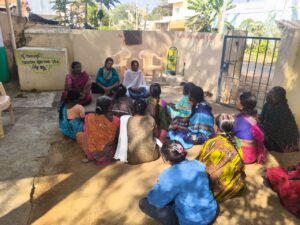
Gender Inequality Index indicators like reproductive health, labor participation, political representation are essential for understanding structural gaps. But many forms of inequality are quiet. They exist in hesitation, in restricted movement, in the emotional labor women perform to keep households functioning. Goonj’s engagement with women is not framed as empowerment from above. It evolves through dialogue, listening to what women are willing to say, and equally to what they struggle to articulate.Some inequalities are not loud enough to be indexed. They must be listened to intentionally.
Sustainable Development Goals (SDGs): Global Targets, Local Conversations
The SDGs offer a comprehensive global framework for development, poverty, health, gender, sanitation, sustainability. Yet, their universal language can flatten local contexts. Targets risk becoming ends in themselves rather than guides shaped by ground realities.
Goonj’s work often aligns organically with SDGs, but without explicit mapping. Local priorities which are decided through listening naturally intersect with global goals. In this sense, deep listening acts as a translator, turning abstract targets into grounded action. It reminds us that sustainability is not a checklist, but a relationship between people, resources, and meaning.
Why Deep Listening Matters for Development
Data tells us where to intervene. Listening tells us how and why. Without deep listening, even well-intentioned programmes can reproduce dependency or overlook dignity when people are treated as beneficiaries rather than interlocutors. Deep listening does not make development slower for the sake of slowness. It makes it truer. It reduces the gap between intention and impact.
Listening Beyond Numbers
Development indices will continue to matter. They help us see patterns, track progress, and hold systems accountable. But they cannot replace attention. They cannot hear hesitation, pride, fatigue, or hope. They cannot tell us when help feels humiliating, or when dignity is quietly restored.
Goonj’s work reminds us that before deprivation becomes a statistic, it is a story, often fragmented, often unheard. Deep listening does not reject data; it completes it. It ensures that development remains human in a field increasingly dominated by dashboards and targets.
Perhaps the future of development lies not only in better indicators, but in better listening. In learning to pause before acting, to stay before solving, and to recognize that dignity cannot be quantified, but it can be cultivated, patiently and together.
By Varsha Valsan
Goonj Setu Fellow, 2025-2026